
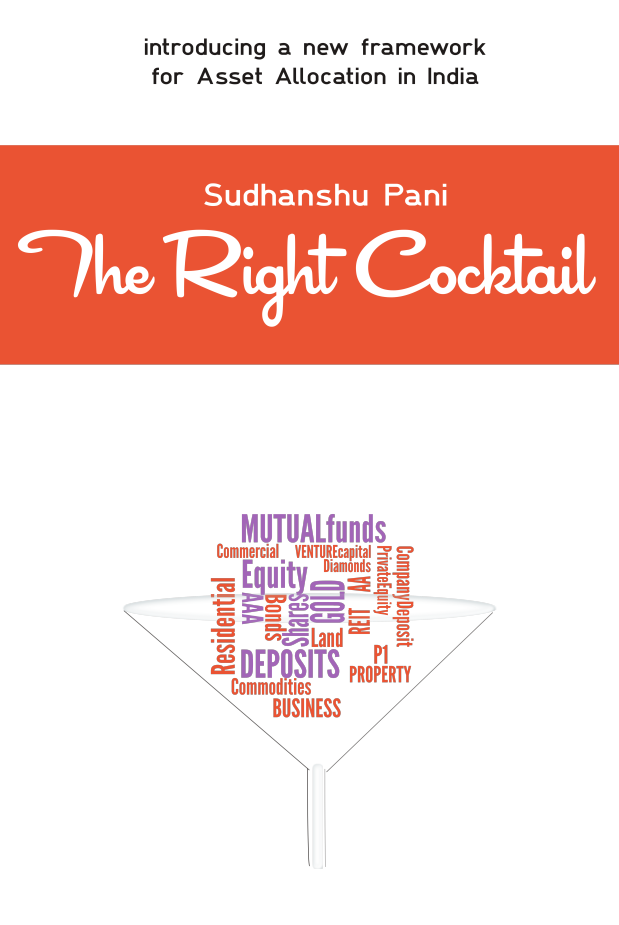
The Right Cocktail: Asset Allocation and Wealth Management in India (print)
A classic book that introduces a new asset allocation framework in India. First edition published in 2016.
A classic book that introduces a new asset allocation framework in India. First edition published in 2016.
A classic book that introduces a new asset allocation framework in India. First edition published in 2016.
More About This Book
Author: Sudhanshu Sekhar Pani
Edition: First Edition
ISBN: 978-935258918
Publication Date: Jan. 1, 2016
A classic book that introduces a new asset allocation framework in India. First published in 2016.The Right Cocktail
Sudhanshu Pani
Asset Allocation – Wealth Management in India
ABOUT THE
AUTHOR

Sudhanshu Pani is a Banker and Wealth Management professional. He is currently employed with ICICI Bank Wealth Management. He has had successful stints with leading banks and as an Entrepreneur he co-founded 'Finance Central', a boutique Wealth Management firm, in 2006.
He is a first rank holder from Indian Institute of Management, Indore
and a graduate in Metallurgical Engineering from Utkal University. He
lives in Mumbai with his better half Jasaswini and daughter
Bhavyaa.
Contents
High rates of Inflation in India 15
Example 2: An Equity Mutual Funds performance 16
1.2 INDIAN INVESTMENT PHILOSOPHY 19
Crux of Indian Investment philosophy 19
1.3 CHARACTERISTICS OF INDIAN ECONOMY AND MARKETS 23
Characteristics of Indian Economy and Markets and What is Changing 23
Parallel Economy and Black Money 25
Polity Immune from the Economy 25
Emerging Regulatory Framework 26
Weak Economic and Judicial Setup 27
1.4 STATE OF INDIAN WEALTH DISTRIBUTION 27
2.0 ASSET ALLOCATION AND PORTFOLIO THEORIES 29
Portfolio Theories - Phases of Emergence 31
1952 – Harry Markowitz introduced the Modern Portfolio Theory 33
1952 – Markowitz introduced his ‘Customary Wealth Theory ‘ 33
1952 – Arthur D Roy introduced a very important theory– Safety First Portfolio Theory 34
1961 – The Capital Asset Pricing Model – a widely used asset pricing model 34
The (Markowitz) efficient frontier and the Market Portfolio 35
1964 – The Efficient Market Hypothesis (EMH) 36
1970s - Complex Non-linear Systems. 37
1973-74 – Tversky and Kahneman discussed their concepts related to heuristics 37
1979-1985 - Green Shoots of Behavioural Paradigm 38
1985-2002 - Strong period of Behavioural Paradigm 38
Loss Aversion and endowment effect 39
The Asset Allocation Puzzle 40
2000 – Shefrin and Statman - Behavioural Portfolio Theory (BPT) 41
2.1 THE FUTURE - ANCIENT INDIAN APPROACH TO WEALTH 44
A study of the ancient Indian texts reveal the following 44
Wealth for consumption is not the goal. Wealth for giving is the objective. 46
Wealth is not the Ultimate Goal 50
3.0 THE INVESTIGATIVE APPROACH 55
Equities, Deposits and Others 55
Construct Portfolios and Calculate Real Returns 56
3.1 DEVELOPMENT OF THE FRAMEWORK 58
Classification of Similar Portfolios 59
5.0 ANALYSIS OF THE BROAD STRATEGIES 63
5.1 PORTFOLIO STRATEGIES FOR 10 YEAR HOLDING PERIOD 64
CONSERVATIVE RISK- LOW RETURN 66
CONSERVATIVE RISK - HIGH RETURN 67
CONSERVATIVE RISK - MODERATE RETURN 67
MODERATE RISK - HIGH RETURN 68
5.2 PORTFOLIO STRATEGIES FOR 5 YEAR HOLDING PERIODS 69
CONSERVATIVE RISK - HIGH RETURN 72
CONSERVATIVE RISK - MODERATE RETURN 73
MODERATE RISK - HIGH RETURN 73
5.3 PORTFOLIO STRATEGIES FOR 3 YEAR HOLDING PERIODS 75
CONSERVATIVE RISK - HIGH RETURN 76
CONSERVATIVE RISK - MODERATE RETURN 77
MODERATE RISK - HIGH RETURN 77
MODERATE RISK - MODERATE RETURN 77
6.0 COMPARATIVE ANALYSIS OF THE PORTFOLIO STRATEGIES 79
What is the kind of information that is depicted? 79
6.2 Concept of Combined Equity+Gold 82
What is the impact of the Combined Equity+Gold allocation on the returns from the portfolios 83
6.4 Relative Influence of Asset Classes 87
How long do good or bad times last 90
7.0 THE BEST PORTFOLIO CHOICES 91
'EIGHT BEAUTIFUL COCKTAILS' 91
7.1 CONSERVATIVE RISK – HIGH RETURN – 10 YEARS 91
7.2 CONSERVATIVE RISK – MODERATE RETURN – 10 YEARS 92
7.3 MODERATE RISK – HIGH RETURN – 10 YEARS 94
7.4 MODERATE RISK – HIGH RETURN – 10 YEARS 94
7.5 CONSERVATIVE RISK – HIGH RETURN – 5 YEARS 96
7.6 MODERATE RISK – HIGH RETURN – 5 YEARS 97
7.7 CONSERVATIVE RISK – HIGH RETURN – 3 YEARS 99
7.8 MODERATE RISK – HIGH RETURN – 3 YEARS 100
Can we change the asset allocation mid-period 103
Can we extend the Investment period 103
8.0 COMPARISON WITH EXISTING APPROACHES 104
9.0 SUMMARISING THE RESULTS 107
10.1 UNDERSTANDING CAPITAL 111
10.2 UNDERSTANDING INTEREST RATES 113
10.3 LAND, RESIDENTIAL AND COMMERCIAL REAL ESTATE 114
First Residential Property 116
Chunky in Nature and high transaction costs 117
Why you should include the property as part of your wealth 118
Subsequent Residential Property 120
10.4 IS THE GOLDEN AGE FOR DEPOSITS OVER 121
The Concept of Cost of Capital 122
10.5 THE CURIOUS CASE OF EQUITIES 122
Indian Equity Market is Unique 123
10.7 CONCEPT OF SURPLUS FUNDS 126
11.0 WEALTH MANAGEMENT WHEN YOU ARE IN YOUR TWENTIES 127
Life, Lifestyle & Aspirations 127
Your economic background - Are you endowed 128
Why education matters in India? 128
12.0 WEALTH MANAGEMENT IN YOUR THIRTIES 131
Work related relocation and travel 132
Life insurance becomes absolutely necessary 133
Catching up on developmental tasks 133
Do you really have a surplus? 134
Decreasing career span structure 134
Break down in relationships, divorce 135
Parting with loved ones - Death 135
The Asset Allocation framework for Thirties 136
13.0 WEALTH MANAGEMENT IN FORTIES - CHALLENGES AND ASSET ALLOCATION 136
Higher Education for Children 136
Children as extension of Self 139
Asset Allocation needed for rebalancing 139
Elderly population working 140
Physically disabled among 60+ 141
Perception regarding one’s health 141
When you lose one in a pair 142
The Real Estate (Regulation And Development) Bill 2016 151
PROLOGUE
Managing wealth, preserving wealth and making money out of one's own wealth is a difficult task. Most individuals, especially the educated and half informed, err on the wrong side in underestimating the difficulty of this exercise. In my experience of 12 years as a part of the Wealth Management Industry, I have learnt that there is no better teacher than one's own experience and there is no short cut to this. Others' experience, of course acts as triggers or guides in ones' own journey. It is important in its own right and I am not discounting it. This book is infact one such exercise where I share my experience and ideas and a radical new framework to manage one's wealth in India.
Did I mention radical? Yes. It believe it would surprise everyone - the professionals and Investors. All of us believe we know everything related to managing wealth and there is nothing new that can come. Managing wealth is a combination of a conceptual framework and an execution of the strategies. The execution becomes extremely challenging when faced with the environmental variables. There is uncertainty of the highest order involved. When myriad forces related to the economy, market, people and geographies interact, there is only short lived homoeostasis. Managing better outcomes for one's wealth is an important objective for the individual investors and the professional community supporting them.
Most of the work on wealth management, asset allocation and Investing, has been done in the west. I am yet to come across an effective adaptation of these Ideas to the Indian context or even an original. This is because it is difficult to adapt the western cases / models to Indian context. I would consider an attempt to do so as an exercise borne out of laziness. The Indian context is unique and the use case in terms of Wealth to be managed is huge. It deserves its own models. I feel a huge responsibility rests on my shoulders to contribute to developing a framework that can help millions of people in their lives. We do have some good books on investing in India, written in the Indian context. Some of these works, I cursorily review in bookstores and these seem 'novellish'. They either lack rigorous framework or practical utility. This book aims to help individual investors and financial advisors use a better asset allocation framework that I have developed specifically for the Indian context.
I have a fleeting notion (not tested rigorously) that advisers and asset managers have not made money for clients in India. Although I cannot delve too much into this without a rigorous data exploration, I have always felt it is a disgrace on people who are otherwise very smart professionals. However, the issue does not lie in the intent of advisors or asset managers. It lies in the randomness and the complex inter-connections in the economic landscapes. It is important to understand what we can contribute and execute that. We can participate in the remaining process in terms of travelling through the randomness with the client. I am referring to outcomes that can be obtained with higher degrees of certainty, as opposed to those that cannot be delivered with higher degrees of certainty. The research towards this book is an effort to help the industry achieve the above.
My aim is to provide the right 'education' that can inturn help set the correct expectation among investors and their advisors from their wealth. Secondly, both entities can take more informed decisions.
You May Also Like

Related Product
₹999